
Five for Friday – September 4, 2026
Rate Hikes, Midterms, Momentum, Commodities, and Prices
1. Rates
With the new Fed chair sounding slightly more hawkish than expected in last week’s widely awaited speech, the market now sees nearly 50/50 odds of three interest rate hikes by late 2027 (potentially starting this month), which would reverse last year’s three cuts and leave short-term rates at a level where they spent most of 2025. It would also mark just the eighth “hiking cycle” of the last 40 years. And while I’ve disagreed that rates need to be higher (me on CNBC last week; "rates" clip starts at 2:40), investors are typically better served by respecting rather than fighting the market's collective judgment. While higher rates are often viewed as a headwind for stocks, the good news is that history suggests a more nuanced relationship. Since 1950 the S&P 500 has averaged, following the first hike in a tightening cycle, a gain of 6% after one year and 38% after three years (with positive returns in 6 of 7 periods over both horizons). Higher rates might be a hurdle for stocks…but they’re not a wall.
2. Elections
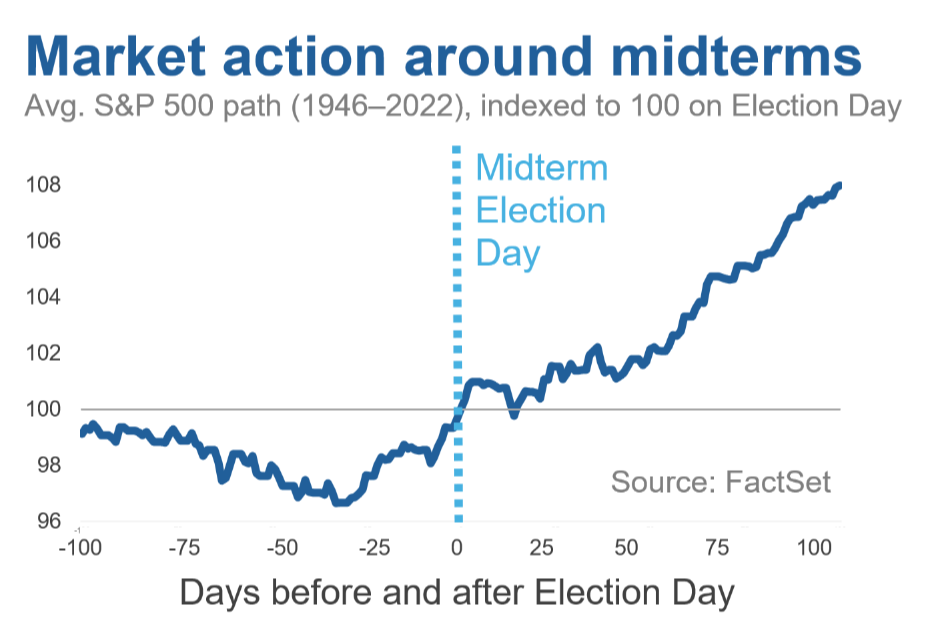
This year has so far bucked the trend of heightened market volatility in mid-term years, but that doesn’t mean investors should let their guard down. September has historically been the worst month for stocks, and the pre-midterm path could still get rocky – especially with AI becoming a hot-button political issue. Should anti-data center rhetoric continue apace, the big tech names that led the market higher could struggle. A positive is that the midterms tend to act as a clearing event – once that layer of uncertainty is removed, stocks have tended to stride higher. Since 1938, S&P 500 returns have not been negative in the 12 months following a midterm election even once.
3. Fall
While higher volatility should be expected (especially compared to how quiet things have been), there are also some good signs for the final months of 2026. The market was positive from January to August in 74 of the last 100 years; in those 74 years, the average return from September to December was +4.5% (and when the S&P 500 was up by double digits in those first eight months – as was the case this year – the average for the rest of the year rises to nearly +6%). In the other 26 years, the average return for the final four months was negative. As with many things in life, early momentum can lay the foundation for later success.
4. Commodities
One takeaway from putting together Baird’s August Chartbook (available to clients on request) was that the broad (Bloomberg) commodities index had its highest monthly close since 2013. Industrial metals, agricultural commodities, and energy products are all up double digits year-to-date. Whether this is the early stage of a supercycle or not, years of underinvestment, geopolitical turmoil, and a massive wave of AI spending seem to be pressuring the commodity complex in ways it was not built to handle. Now, on one hand, people are spending, investing, and building, and that’s a good sign for growth. On the other hand, higher commodity prices are fueling the type of broader and stickier inflation that policymakers and consumers despise. Given that backdrop, it’s hard to see interest rates coming down meaningfully anytime soon, regardless of what the Fed does this month.
5. On this day
in 1972, The Price Is Right debuted its modern format (the first item up for bid? A $595 muskrat coat). As TV’s longest-running game show, it serves as a fun economic time series – a 2019 study found that recent players were more likely to underestimate prices than those from earlier generations, implying either that new technology has reduced the benefit of retaining that info…or that people simply pay less attention to prices now. The good news for future contestants (and bad news for everyone else) is that inflation has given us a reason to pay attention to prices once again.
Disclosures
This is not a complete analysis of every material fact regarding any company, industry or security. The opinions expressed here reflect our judgment at this date and are subject to change. The information has been obtained from sources we consider to be reliable, but we cannot guarantee the accuracy. Market and economic statistics, unless otherwise cited, are from data provider FactSet.
This report does not provide recipients with information or advice that is sufficient on which to base an investment decision. This report does not take into account the specific investment objectives, financial situation, or need of any particular client and may not be suitable for all types of investors. Recipients should not consider the contents of this report as a single factor in making an investment decision. Additional fundamental and other analyses would be required to make an investment decision about any individual security identified in this report.
For investment advice specific to your situation, or for additional information, please contact your Baird Financial Advisor and/or your tax or legal advisor.
Past performance is not indicative of future results and diversification does not ensure a profit or protect against loss. All investments carry some level of risk, including loss of principal. An investment cannot be made directly in an index.
Copyright 2026 Robert W. Baird & Co. Incorporated.
Other Disclosures
UK disclosure requirements for the purpose of distributing this research into the UK and other countries for which Robert W. Baird Limited holds an ISD passport.
This report is for distribution into the United Kingdom only to persons who fall within Article 19 or Article 49(2) of the Financial Services and Markets Act 2000 (financial promotion) order 2001 being persons who are investment professionals and may not be distributed to private clients. Issued in the United Kingdom by Robert W. Baird Limited, which has an office at Finsbury Circus House, 15 Finsbury Circus, London EC2M 7EB, and is a company authorized and regulated by the Financial Conduct Authority. For the purposes of the Financial Conduct Authority requirements, this investment research report is classified as objective.
Robert W. Baird Limited ("RWBL") is exempt from the requirement to hold an Australian financial services license. RWBL is regulated by the Financial Conduct Authority ("FCA") under UK laws and those laws may differ from Australian laws. This document has been prepared in accordance with FCA requirements and not Australian laws.


